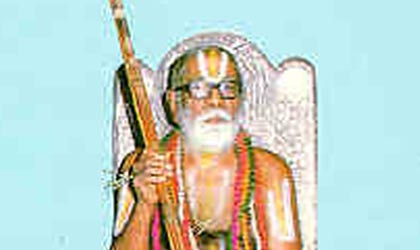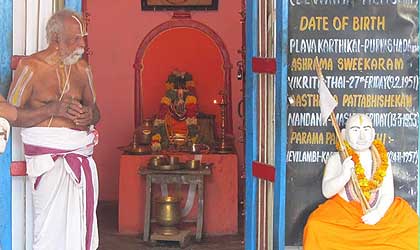
The First Azhagiya Singar
Place: Kancheepuram
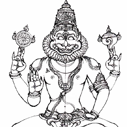
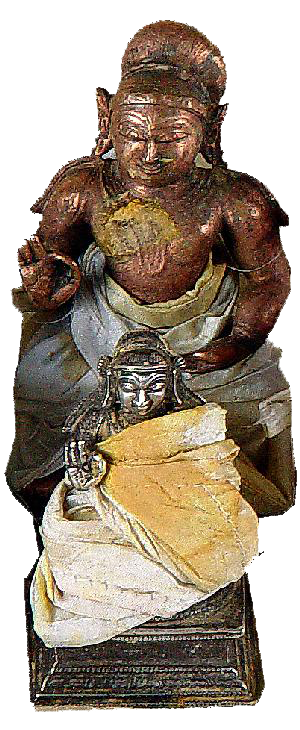
The Jeeyar though anxious to start on his mission right earnestly, could not decide on the 'Utsava' Moorthi he could take with him. He, therefore, went into a meditation and prayed that the most suitable Moorthi' should come and bless him. Immediately the 'Utsava Moorthi' of Malola Narasimha (Lakshmeenarasimha) came flying from the temple and seated Himself on the outstretched hands of the Jeeyar. Mukundaraya on hearing of this miracle became his disciple and offered not only arrangements for permanent daily worship but also gave a palanquin and other paraphernalia to assist the Jeeyar in his sanchara (tour) along with the 'Malola' Moorthi. He also gave control of all the temples to this Jeeyar and henceforth Ahobila Kshetram came under the direct control of Ahobila Mutt whose pontiffs are even today the hereditary trustees.
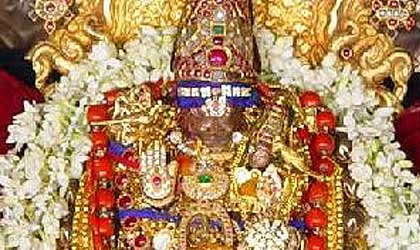
Now a look at the 'Malola' Moorthi will reveal that He wears a Paduka indicating that He is ready to proceed on tour and thus both the Jeeyar and his God fully equipped commenced their historic travel giving spiritual and material succour to all who prayed in the course of their travel. Bearing the name Satakopa as he was, it was natural that this first Jeeyar should be eager to visit Alwarthirunagari the holy place sacred to Nammalwar. Having reached Alwarthirunagari, he found to his dismay and grief that the temple of Nammalwar was completely changed to one wherein eleven images of siva (linga) had been installed and had come to be called Ekadasarudra Kshetra. The idol of Nammalwar was not to be found anywhere. Setting up his camp there, Satakopa Jeeyar went about his routine of preaching the doctrine of surrender (prapatti) and gradually his fame spread as a mystic saint of great powers and efficacy. Distressed at the loss of Nammalwar and his shrine, he constantly recited Madurakavi's stanzas when Nammalwar appeared before him in a vision, told him that his idol lay in the bed of a river adjacent to a ravine and that the Jeeyar should recover and restore it. It so happened that the Pandya King of that place was on a hunting trip around those parts and the Jeeyar's divine personality instantly attracted him. He fell at the Jeeyar's feet and solicited to become a convert to Vaishnavism. Accompanied by this king, the Jeeyar went to the spot of the difficult terrain and prayed to Nammalwar and lo! the image slowly emerged from the river bed and settled on the outstretched arms of the Jeeyar just as 'Malola' Moorthi had done so earlier!! The King was spellbound and without hesitation, (on the orders of the Jeeyar), he straightway removed the saivite images and installed the Nammalwar's idol in the temple as before with due pomp and favour thus restoring the temple's pristine Vaishnavite glory. The British historian Mr. Sewell's list. of South Indian Dynasties cull out one Kulasekhara Pandya as the reigning chief of this period (vide History' of the Ahobila Mutt by S.N. Venkatesa lyer).
But the fact remains that the Pandya king whoever he was had built Mandapams etc., at the temple and also made other arrangements for worship at the instance of the first Jeeyar. The mandapam and other structures stand even today on the banks of the river Tamraparani as also a shrine for Vedanta Desika constructed by this saint. The king so adored this Jeeyar that he made a true image of this Adivan Satakopa Jeeyar and had it duly installed in the Nammalwar shrine 'in Alwarthirunagari. Pleased with the loving service of this Jeeyar, Nammalwar gave him the name Adi (first), Van (powerful) Satakopa (Nammalwar's own name) by which the Jeeyar came to be called. Henceforth the successive Jeeyars have always the prefix "Van Satakopa". Vedanta Desika for his part gave this Jeeyar the suffix Mahadesikan as also the various titles (i) Srimat Vedamarga Pratishtapanacharya, (ii) Paramahamsa Parivraajaka, (iii) Ubhaya Vedantacharya, (iv) Sarvatantra Swatantra and (v) Bhagavat Ramanuja Siddhanta Nirdharana Sarvabhouma. It will be significant to note that even today, whenever and wherever the Jeeyars go, the air resounds with the cries of these names chanted loudly by the followers of the mutt. Suffice it to say that Yateendra (best of saints) applied very appropriately not only to this Jeeyar but to every successive Jeeyars. This term is not applied to any other holy order of which there are many.
This Pandyan King's incident was heard by King Mukundadeva Raya of Orissa who was wandering in wilderness, having lost his kingdom to the Muslims. Keeping himself abreast of the times, the Jeeyar felt it was expedient to come to the rescue of this exiled monarch who had sought his help. The Guruparampara describes the miracle of the pride of lions (Remember that Man-lion manifestation of God) invaded Orissa and put to flight the philandering Muslims who in sheer fright handed back the kingdom to Mukundadeva Raya and fled never to return. While the Jeeyar was admiring the ways of his pet God Narasimha, the King fell at the feet of this Jeeyar in great gratitude and accorded him all honours befitting the occasion (vide history of Ahobila Mutt by S.N. Venkatesa lyer). It is specially mentioned by the 7th Jeeyar in his famous samskrit drama 'Vasantika Parinayam'. Taking leave of the Orissa King, the Jeeyar, Sree Adivan Satakopa Yateendra Mahadesikan then proceeded towards Vijayanagar Kingdom whose Rajah received him with full honours and gave him grants and presents. It was at this time that one Manappakkam Thozhappar became the Jeeyar's disciple getting Panchasamskara as also expert knowledge in Sreebhashyam, Bhagawad Vishayam and Rahasyatrayasaram at the Jeeyar's feet. Marveling at the wisdom and learning of this Thozhappar, the Jeeyar asked him to write authoritative text on various Sastras which Thozhappar did under eight different heads earning the deserving title 'Vaidika Sarvabhouma'. As the head of the 74 Simhasanadhipathis, this Jeeyar Adivan Satakopa then trekked his way to Thirukudantai (Kumbakonam) to worship Lord Aravamudhan and then proceeded further south to Nammalwar's place where he constructed a Mutt with all conveniences for the benefit of Srivaishnavas. From here the Jeeyar went to Thirunarayanapuram (Melkote) where after worshipping Ramanuja, Selva Pillai and Yadugiri Nachiyar, he set up a camp on the banks of the Kalyani Pushkarani where he taught Sreebashyam and Rahasyatrayasaram to many Srivaishnavas.. One day, people beheld the wonder of a five-headed serpent spreading its hood and listening to the exposition of the Jeeyar's lucid interpretation of Ramanuja's philosophy. The class was not perturbed and at the end of the session, the serpent glided slowly and disappeared. That Ramanuja was the incarnation of Adisesha impressed heavily on the audience who with one voice agreed that Ramanuja Himself gave darsan now in the guise of a serpent and gave his approval of Jeeyar's interpretations!
The King of those parts sought the Jeeyar's benediction to get rid of his ailment and lo! his cure came as soon as he renovated the Rajagopuram of the Thirunarayanapuram Ternple at the instance of the Jeeyar, who also installed the Vigraha of Vedanta Desika there. In fulfillment of the desire in a vision of Lord Venkatesvara, the Jeeyar then went to Thirupathi and camping there for sometime, he built a Mutt both at Thirumala and Thirupathi, where idols of Lakshmeenarasimha were consecrated by him. He also provided steps to climb the Thirumala Hills and constructed several Mandapams on the way so that the pilgrims could rest while negotiating the steep climb. The jiyar then reached Kancheepuram where he built a 1,000 pillared Mandapam in the Varadaraaja swami Temple and even now, one can witness a Lakshmeenarasimha image in one pillar opposite to which is the figure of the Jeeyar in another pillar. It is said that this mandapam was, constructed from out of the wealth surrendered to the Jeeyar by a scholar by name Udayabhanu Misra who lost to the former in vedantic debate. It seems this debate lasted nearly a fortnight when Vedanta Desika appeared to the Jeeyar in a vision and told him to deal the matter by referring to his (Desika's) treatise Sathadooshani, with the result Udhayabhanu accepted defeat and became a disciple of the Jeeyar, who also built a frontal Mandapam and temple for Deepa Prakasa at Thooppul and also a mandapam and Sannidhi for Vedanta Desika whose idol was also duly installed there. After all this, the Jeeyar took the road towards Sholingar visiting Thirupathi on the way again and then proceeded to Sriperumbudur, the birthplace of Ramanuja. From there he found his way straight to Srirangam where he was received with full honours given to the prince among ascetics. Never was the reception so spontaneous as was given here. Staying in this holy city, he renovated the saptaprakara walls as was done by Thirumangai Azhwar earlier and Jataavarman Sundarapandya a little later. At the northern entrance of the temple, he constructed his mutt wherein the idol of Lakshmeenarasimha as also his own image were installed. Then on divine command, he built a frontal mandapam at Dasavatharam Sannidhi (built by Thirumangai Azhwar). Again as per Ranganatha's wishes, he built a Sannidhi for Vedanta Desika in front of the Srirangam Nachiyar Sannidhi and made arrangements for the daily worship there. The northern Gopuram was built at his instance where his image can be seen even today. He also constructed a mutt at the eastern gate of the Uttara Street duly consecrating an icon of Lakshmeenarasimha. Having thus given fixity and method to the activities, the Jeeyar was called upon to go to Melkote for the worship of Thirunarayanan.
It is significant after that sixty years of divine service in his Sanyasa asrama', and at an advanced age, the Jeeyar should come back to his place of birth where he shed his mortal frame so as to be in the constant company of Sreeman Narayana in Sreevaikunta. This happened in April 1458 C.E. and his Brindavan in Melkote is a beacon light to his followers even to this, day. He was succeeded by the eminent Nambakkam Swami Srivan Satakopa Sriman Narayana Yateendra Mahadesikan.
Source: Sri Nrusimha Priya, sambutam 53, sancigai 7, bava aippasi (October 94), pp. 32 - 37 |
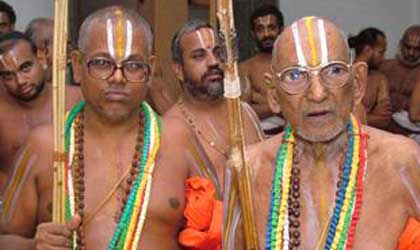
Sri Malolan in the divine hands of
Sri Malolan of Sri Ahobila Mutham
Nammazhvar
|



Previous Next